Wednesday 30 Sep ★ Key
EZ + STR-A
Easy run + Strength A (heavy)
Recorded, not confirmed 0:42 of 40 min · 6.2 km · 21 m D+ · gym logged
The weekly review confirms what this activity counts for; until then it isn't marked done.
Aerobic volume, frequency + Maximal strength, running economy, general robustness (injury prevention in runners is unproven)
What you did
Run
Z1 3% · Z2 73% · Z3 25%
Laps (4)
| # | time | km | D+ | HR | GAP |
|---|---|---|---|---|---|
| 1 | 5:00 | 0.69 | 1 | 140 | 7:02 |
| 2 | 30:00 | 4.44 | 17 | 153 | 6:42 |
| 3 | 4:59 | 0.69 | 3 | 146 | 7:01 |
| 4 | 2:39 | 0.37 | 0 | 146 | 6:60 |
The plan
Intensity: Z1–Z2 · 140–152 bpm · RPE 2–3
Duration: 40 min
🏋 STR-A heavy legs + push/pull (~40–45 min, the main session)
1 × 8–10 · RIR 3–4 (easy-moderate)
Stage 1 · reduced: Learn the movements and find your weights; some soreness is expected Today: 1 set per exercise (week plan).
Warm-up (5 min)
stair simulator or bike 3 min → 10 bodyweight squats, 10 glute bridges, 10 leg swings per side.
Gym words (new to the gym? read this)
- Rep: one lift up and down (one squat, one press).
- Set: a group of reps done in a row without resting. "2 × 10" means 2 sets of 10 reps: do 10, rest, do 10 more.
- RIR (reps in reserve): how many more good reps you could still have done at the end of a set. RIR 3 = you stopped with 3 left in the tank. Weeks 1–2 aim for RIR 3–4: it should feel easy to moderate.
- Paired exercises (1a + 1b, 2a + 2b, 4a + 4b, 5a + 5b): two different exercises done in turns. Do one set of a, then one set of b, rest about 1 minute, and repeat until all sets are done. They are *both* part of the workout, not choices. A number with no letter (3) is done on its own: all its sets, resting about 1 minute between them.
- Swap: an alternative exercise, used only if the listed machine or weights aren't free.
- Per hand / total: dumbbell weights are per hand (8 kg = one 8 kg dumbbell in each hand). Barbell and machine weights are the total on the bar or stack.
- Watch: the COROS body part to select for the set. COROS offers Whole Body, Shoulders, Chest, Back, Core, Legs/Hips and Arms (APEX 4 guide, support.coros.com). After each set the watch asks for reps and weight: enter the reps you did and the same weight you'd log here (per hand for dumbbells, 0 for bodyweight). COROS publishes no rule on per hand vs total (checked 2026-09-30). It only multiplies weight × reps for its "volume" number, so with per-hand entries COROS's dumbbell volume reads half of what you actually lifted. That's fine: the coach reads the log, not COROS volume.
Do every exercise, top to bottom. 1a + 1b: one set of a, one set of b, rest ~1 min, repeat. "Swap" is only for a busy machine. ⌚ = body part to pick on the watch. Tap an exercise for the video and cues.
1aBulgarian split squat, dumbbells8 kg per hand · 1 × 8–10 · ⌚ Legs/Hips
Starting estimate: a coach guess, not a tested capacity. Use the first-session rule.
Logged on 2026-09-30: 1 × 10 @ 8 kg per hand, RIR 2
 ▶ Play demo
Bulgarian Split Squat with Dumbbells · open on YouTube
Not reviewed yet: the link was checked to exist, not the technique shown.
Cues: rear foot laces-down on a bench; front foot far enough forward that you can drop straight down. Slight forward lean of the torso is fine (more glute). Lower until the back knee is just above the floor, push up through the whole front foot.
Avoid: front foot too close (heel lifts); bouncing out of the bottom; most of the weight on the back leg.
Easier: bodyweight, or hold a rack for balance. Harder: heavier dumbbells, 3 s lowering.
Swap if busy: Smith split squat (empty bar) · single-leg leg press (30–40 kg)
Swap: Smith machine split squat (swap for BSS)
 ▶ Play demo
Smith Machine Split Squat · open on YouTube
Not reviewed yet: the link was checked to exist, not the technique shown.
Cues: bar on upper back, feet in a long split stance under the bar; drop straight down, back knee toward the floor.
Swap: Single-leg leg press (swap for BSS)
 ▶ Play demo
How To Do A Single Leg Press · open on YouTube
Not reviewed yet: the link was checked to exist, not the technique shown.
Cues: foot mid-platform, knee tracks over the second toe; lower until the hip starts to tuck, then press.
Why: Quads/glutes, single-leg strength for climbs and descents
1bDumbbell bench press10–12 kg per hand · 1 × 8–12 · ⌚ Chest
Starting estimate: a coach guess, not a tested capacity. Use the first-session rule.
Logged on 2026-09-30: 1 × 10 @ 6 kg per hand, RIR 1
 ▶ Play demo
How To Do A Dumbbell Bench Press · open on YouTube
Not reviewed yet: the link was checked to exist, not the technique shown.
Cues: feet flat, shoulder blades pulled back and down into the bench; lower the dumbbells to the sides of the chest with elbows at ~45° from the body (not flared out to 90°); press up and slightly in.
Avoid: elbows flared wide; bouncing off the chest; lower back arching off the bench.
Swap if busy: Machine chest press (20–25 kg) · push-ups (hands on a bench if needed)
Swap: Machine chest press (swap for DBBP)
 ▶ Play demo
How To Use The Chest Press Machine · open on YouTube
Not reviewed yet: the link was checked to exist, not the technique shown.
Cues: seat height so the handles are at mid-chest; back against the pad; press without locking the elbows, return slowly.
Swap: Push-up (swap for DBBP; no equipment)
 ▶ Play demo
How To Do Press Ups · open on YouTube
Not reviewed yet: the link was checked to exist, not the technique shown.
Cues: hands just outside the shoulders; body in one straight line from head to heels; chest to a fist's height from the floor.
Why: Chest, shoulders, triceps
2aRomanian deadlift, barbell or dumbbellsRomanian deadlift (barbell): Barbell 30 kg total (20 kg bar + 5 kg each side) · Romanian deadlift (dumbbells): dumbbells 12 kg per hand · 1 × 8–10 · ⌚ Legs/Hips
Romanian deadlift (barbell): Starting estimate: a coach guess, not a tested capacity. Use the first-session rule.
Romanian deadlift (barbell): Logged on 2026-09-30: 1 × 10 @ 30 kg total, RIR 2
Romanian deadlift (dumbbells): Starting estimate: a coach guess, not a tested capacity. Use the first-session rule.
 ▶ Play demo
How to do a Romanian Deadlift (Barbell) · open on YouTube
Not reviewed yet: the link was checked to exist, not the technique shown.
Cues: soft knees; push the hips back, not down; bar slides down the thighs; stop when the hamstrings are stretched (usually just below the knee), then drive the hips forward.
Avoid: rounding the lower back; turning it into a squat; bar drifting away from the legs.
Romanian deadlift (dumbbells)
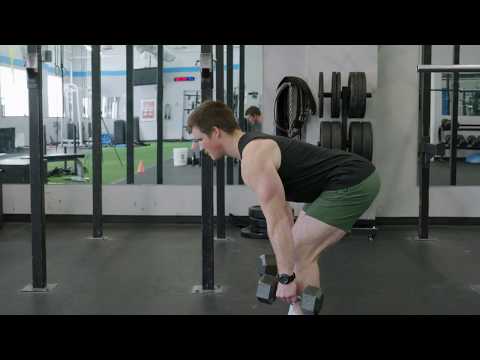 ▶ Play demo
Dumbbell Romanian (RDL) Deadlift, technique for beginners · open on YouTube
Not reviewed yet: the link was checked to exist, not the technique shown.
Cues: as RDL, dumbbells along the front of the thighs.
Swap if busy: 45° back extension (bodyweight, then hold a 5–10 kg plate) · cable pull-through (15–20 kg)
Swap: 45° back extension, glute bias (swap for RDL)
 ▶ Play demo
45 Degree Hip Extension (Glutes & Hamstrings Bias) · open on YouTube
Not reviewed yet: the link was checked to exist, not the technique shown.
Cues: pad just below the hip crease; hinge at the hips with a neutral spine; squeeze the glutes to come up to a straight line, not beyond. Hold a plate to load it.
Swap: Cable pull-through (swap for RDL)
 ▶ Play demo
Cable Pull Through · open on YouTube
Not reviewed yet: the link was checked to exist, not the technique shown.
Cues: face away from a low cable, rope between the legs; hips back, then snap them forward and squeeze the glutes; arms just hold the rope.
Why: Hamstrings/glutes, hip hinge
2bSeated cable row25–30 kg · 1 × 8–12 · ⌚ Back
Starting estimate: a coach guess, not a tested capacity. Use the first-session rule.
Logged on 2026-09-30: 1 × 12 @ 25 kg, RIR 3
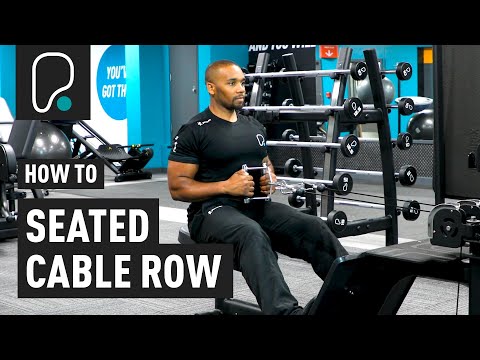 ▶ Play demo
How To Do A Seated Cable Row · open on YouTube
Not reviewed yet: the link was checked to exist, not the technique shown.
Cues: sit tall, knees slightly bent; pull the handle to the lower ribs by driving the elbows back and squeezing the shoulder blades together; let the arms straighten fully on the way back without rounding the back.
Avoid: rocking the torso back to move the weight; shrugging.
Swap if busy: Chest-supported dumbbell row (10–12 kg per hand)
Swap: Chest-supported dumbbell row (swap for SCROW)
 ▶ Play demo
How To Do An Incline Dumbbell Row · open on YouTube
Not reviewed yet: the link was checked to exist, not the technique shown.
Cues: lie face-down on an incline bench; row both dumbbells toward the hips, elbows close; pause at the top.
Why: Upper back, biceps, posture
3Step-up to knee-height box, dumbbells (3 s slow lowering)6 kg per hand · 1 × 8–10 · ⌚ Legs/Hips
Starting estimate: a coach guess, not a tested capacity. Use the first-session rule.
Logged on 2026-09-30: 1 × 10 @ 6 kg per hand, RIR 2
 ▶ Play demo
How To Do A Dumbbell Step Up · open on YouTube
Not reviewed yet: the link was checked to exist, not the technique shown.
Cues: whole foot on the box; drive up through the top leg without pushing off the bottom foot; stand tall; lower in 3 s with the same leg, lightly touch the floor.
Avoid: springing off the back foot; dropping down fast (this is the eccentric part that protects your quads on descents).
Easier: lower box. Harder: heavier dumbbells, then higher box.
Swap if busy: Leg press (60–80 kg including the sled; check what the sled weighs)
Swap: Leg press (swap for STEP)
 ▶ Play demo
How To Use The Leg Press Machine · open on YouTube
Not reviewed yet: the link was checked to exist, not the technique shown.
Cues: feet hip-width, mid-platform; lower under control until the hips start to lift, press without locking the knees.
Why: Climbing, eccentric control for descending
4aStanding calf raise (machine, straight knee)Light load (weight not specified) · 1 × 8–10 · ⌚ Legs/Hips
Starting estimate: a coach guess, not a tested capacity. Use the first-session rule.
Logged on 2026-09-30: 1 × 12 @ 50 kg, RIR 2
 ▶ Play demo
Hammer Strength Select Standing Calf Raise · open on YouTube
Not reviewed yet: the link was checked to exist, not the technique shown.
Cues: balls of the feet on the edge; full stretch at the bottom, pause 1 s; rise as high as possible; lower in 2–3 s. Knees straight but not locked.
Avoid: bouncing; half reps.
Why: Calf and Achilles capacity for steep terrain
4bSeated calf raise (machine, bent knee)Light load (weight not specified) · 1 × 8–10 · ⌚ Legs/Hips
Starting estimate: a coach guess, not a tested capacity. Use the first-session rule.
 ▶ Play demo
Seated Calf Raise Machine · open on YouTube
Not reviewed yet: the link was checked to exist, not the technique shown.
Cues: as SCR. The bent knee shifts work to the soleus, the calf muscle that carries most of the load on climbs.
Why: Soleus, the calf muscle that carries most of the load on climbs
5aSide plank, 1 × 30 s per sideBodyweight · ⌚ Core
Not logged before.
Logged on 2026-09-30: 1 × 30, RIR 2
 ▶ Play demo
Side Plank · open on YouTube
Not reviewed yet: the link was checked to exist, not the technique shown.
Cues: elbow under the shoulder; straight line from head to feet; don't let the hips sag. Easier: knees bent.
Swap if busy: Knees-bent side plank
Why: Trunk
5bDead bug, 1 × 8 per sideBodyweight · ⌚ Core
Not logged before.
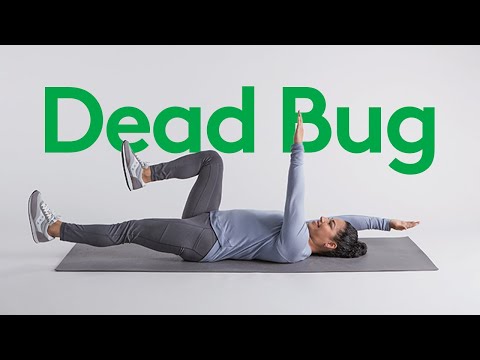 ▶ Play demo
How to Do a Dead Bug · open on YouTube
Not reviewed yet: the link was checked to exist, not the technique shown.
Cues: lower back pressed into the floor the whole time; extend opposite arm and leg slowly, breathe out as you reach.
Swap if busy: —
Why: Trunk
Adding weight, reps for upper body
Adding load: when every set reaches the top of the rep range at the target RIR, go up one step next session: dumbbells +1–2 kg per hand, barbell +2.5–5 kg, machines one plate or pin. If a set falls short of the bottom of the range, keep the weight.
Upper body follows the same sets and RIR but stays at 8–12 reps (6–10 from week 6). It's there for general strength and health, carrying a pack and using poles, not running performance, so there's no need to go very heavy.
Stop any exercise that causes sharp or joint pain. Tell the coach your weights afterwards so next targets update.
About this session type
EZ · Easy run: Aerobic volume, frequency. Typical: 30–75 min. The bulk of training.
STR-A · Strength A (heavy): Maximal strength, running economy, general robustness (injury prevention in runners is unproven). Typical: 30–45 min: 3–4 exercises × 3–4 sets × 3–8 reps heavy (RIR 1–3). Squat or split squat, RDL/hinge, step-up, heavy calf raise (straight + bent knee). Athlete's routine: plans/strength-routine.md.